The Gen Z Surge: Why the “Loneliest Generation” is Clocking Into Church


For years, the headlines about Gen Z and religion were predictable: “The Rise of the Nones,” “The Great Dechurching,” and “Empty Pews.” But as we move through 2026, the narrative has taken a fascinating turn. Data from Gallup and Barna shows a measurable uptick in religious attendance among Gen Z, particularly among young men, who are now outpacing older generations in regular church participation.
The data coming in for 2026 confirms that the “Gen Z Surge” isn’t just a social media trend—it is a measurable shift in religious engagement. Recent reports from Gallup, Barna, and the Springtide Research Institute highlight a significant realignment, particularly regarding young men and frequency of attendance.
Key Statistics on the Gen Z Surge
| Metric | Previous Data (2020–2023) | Current Data (2025–2026) | Source |
| Weekly/Monthly Attendance | ~33% (Young Men) | 40% (Young Men) | Gallup (April 2026) |
| Importance of Religion | 28% (Very Important) | 42% (Very Important) | Gallup (April 2026) |
| Self-Identified Christians | 49% | 54% | Barna Group (May 2026) |
| Commitment to Faith | Baseline (2022) | +17% increase | Barna Group (May 2026) |
| Anticipating Spiritual Revival | N/A | 38% (Highest of all groups) | Barna Group (March 2026) |
Deep Dive into the Findings
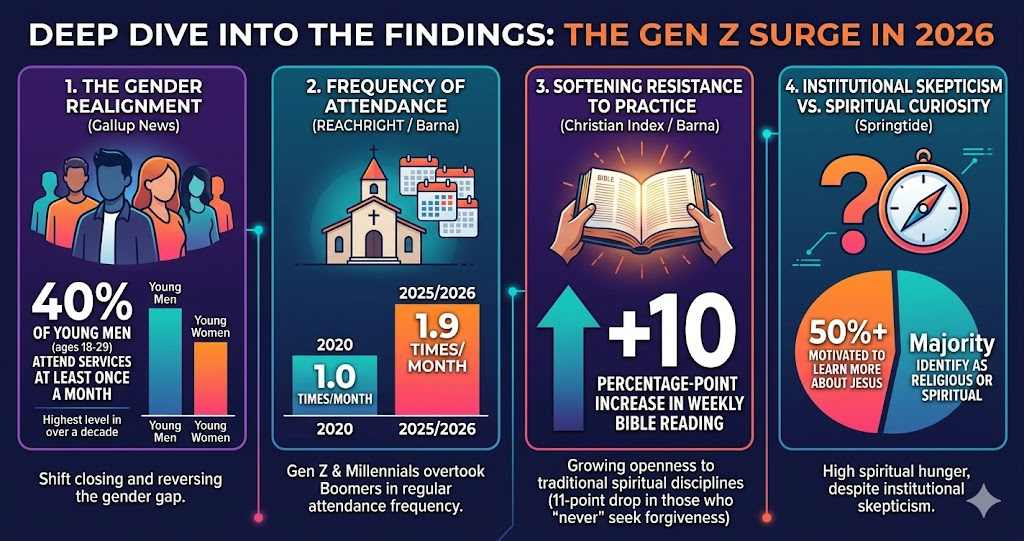
1. The Gender Realignment
For the first time in modern polling history, young men (ages 18–29) are showing a higher rate of religious engagement than young women.
- The Stat: As of April 2026, 40% of young men attend services at least once a month, the highest level in over a decade.
- The Context: This shift is closing—and in some cases reversing—the long-standing “gender gap” in church pews.
2. Frequency of Attendance
Gen Z and Millennials have officially overtaken Boomers in regular church attendance frequency.
- The Stat: In 2020, Gen Z attended church roughly once a month. By 2025/2026, that frequency has climbed to 1.9 times per month.
- The Context: While older generations have stayed steady or slightly declined post-pandemic, younger cohorts have nearly doubled their frequency of attendance since 2020.
3. Softening Resistance to Practice
Gen Z is engaging more frequently in “biblical behaviors,” even if they still struggle with a cohesive biblical worldview.
- The Stat: There has been a 10-percentage-point increase in weekly Bible reading among Gen Z adults over the last four years.
- The Stat: An 11-point drop in those who say they “never” acknowledge their sins or seek forgiveness suggests a growing openness to traditional spiritual disciplines.
4. Institutional Skepticism vs. Spiritual Curiosity
While Gen Z may check “None” on a survey for organizational affiliation, their spiritual hunger is high.
- The Stat: Over half of Gen Z teens say they are motivated to learn more about Jesus.
- The Stat: A majority of young people identify as “religious or spiritual”.
What is driving this surge, and how can streaming video provide a solution?
The church’s “digital front door” is no longer just a static website; it is a high-fidelity, interactive window into the life of the congregation.
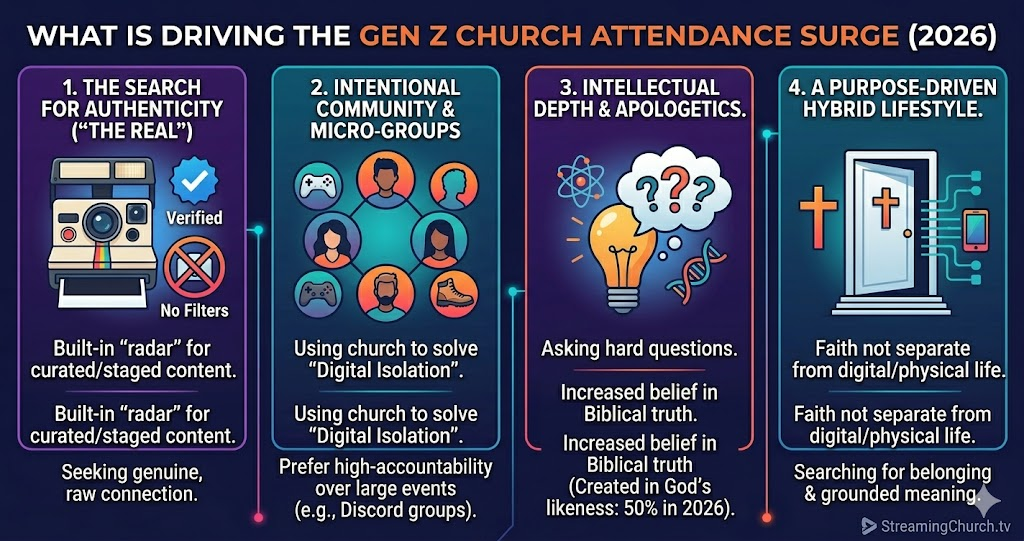
1. The Search for “The Real” in a Deepfake World
Gen Z grew up with curated feeds and AI-generated content. They have a built-in radar for anything that feels staged.
- The Trend: They aren’t looking for a rock concert; they are looking for authenticity.
- The Video Solution: Use high-quality streaming video to capture raw, conversational moments. Whether it’s a high-definition stream of a traditional liturgy or a behind-the-scenes look at ministry prep, the goal is to use professional video production tools like vMix or OBS to provide a clear, honest look at your community—not to mask it behind filters.
2. Community Over Content
Gen Z is often cited as the loneliest demographic, and they are using the church to solve social isolation.
- The Trend: Small, high-accountability groups are outperforming large-scale events.
- The Video Solution: Streaming video isn’t just for the main stage. Implement interactive streaming for micro-communities. Use video calls for virtual small groups or “chat-back” sessions after the service where viewers can engage directly with leaders in real-time.
3. Intellectual Depth and Apologetics
Gen Z is highly analytical, wrestling with massive questions about identity and truth.
- The Trend: A 10-point increase in Gen Z individuals believing they were created in God’s likeness suggests a hunger for foundational truth.
- The Video Solution: Create “Deep Dive” video series or podcasts that tackle science, ethics, and mental health. By using specialized hardware like Blackmagic Design or AJA for your recordings, you ensure the professional quality matches the depth of the intellectual content.
4. Digital Discipleship is Non-Negotiable
To Gen Z, the digital world is not separate from the real world.
- The Trend: They discover faith-based content via short-form storytelling (TikTok/Reels) but use long-form content (YouTube/Livestreams) to go deep.
- The Video Solution: Every church needs a “streaming strategy.” Your livestream allows Gen Z to “audit” your church before they ever step inside. Professional streaming ensures that their first experience is frictionless, clear, and inviting.
The Bottom Line
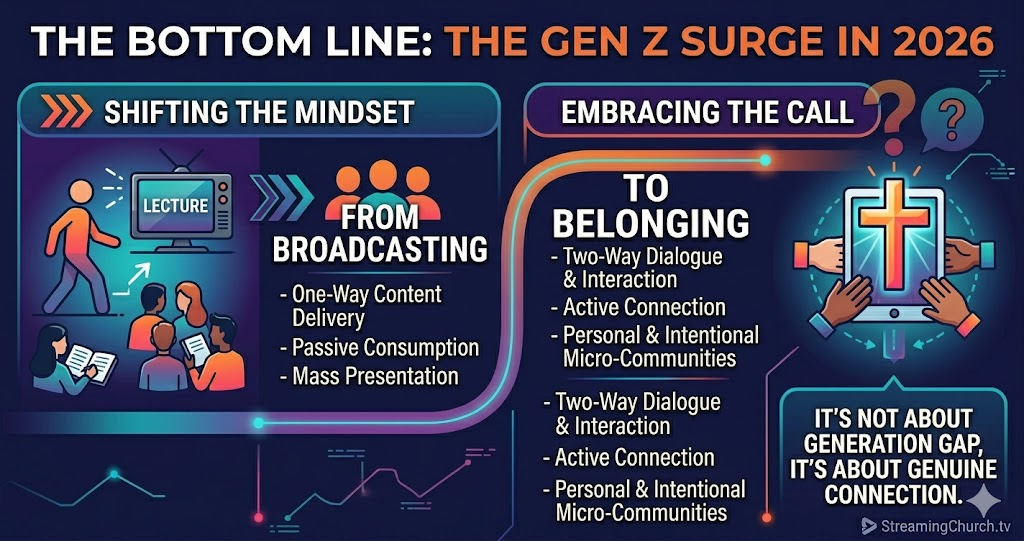
The surge we’re seeing in 2026 isn’t about Gen Z becoming “more traditional”—it’s about them becoming more intentional. They aren’t showing up because they “have to,” but because they’ve found a sense of belonging and a grounded purpose.
Is your church ready to move from “broadcasting” to “belonging”?
At StreamingChurch.tv, we specialize in providing the technical and organizational solutions to make your digital ministry flourish. From vMix troubleshooting to complete workflow optimization, we help you reach the next generation with excellence.
Reach out to StreamingChurch.tv today to elevate your stream and reach the surge.
Primary Sources for Reference:
- Gallup News (April 2026): “Rise in Young Men’s Religiosity Realigns Gender Gaps”
- Barna Group (May 2026): “Study Shows Gen Z Moving Toward Faith”
- Christian Standard (May 2026): “Hope for the Future and What Churches Can Do”
REACHRIGHT Studios (Dec 2025):“40+ Church Statistics for 2026”