Leaving the Booth Well: Why Every Church Tech Person Needs an Exit Strategy

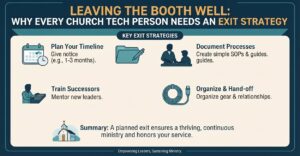
Working for and with churches as I have for decades I sadly see this far too often. The tech person decides to leave the church but exits in a bad way. In many churches, the tech booth is the unsung hub of Sunday morning. It’s a delicate ecosystem of audio mixers, presentation software, streaming encoders, lighting consoles, and network switches. Behind every seamless livestream and worship lyric is a team of people—often volunteers, sometimes paid staff—holding it all together.
But what happens when someone decides to step down?
Whether a volunteer is moving away, experiencing burnout, or stepping back to rest, or a paid technical director is transitioning to a new staff role, departures are inevitable. Yet, in the church tech world, departures are too often handled poorly. An individual simply hands in their keys or stops showing up, leaving the remaining team members scrambling to decode password-protected systems, untangle undocumented cable paths, and figure out how to run Sunday’s service from scratch.
For church tech people, having a thoughtful, intentional exit strategy isn’t just good professional courtesy—it is a vital act of Christian stewardship and love for the local body.
Here is why every church tech person needs an exit strategy, and what it looks like to leave your team in a position to thrive rather than scramble.
1. The Principle of Stewardship: Leaving It Better Than You Found It
As believers, we are called to be faithful stewards of the resources and responsibilities entrusted to us (1 Peter 4:10). In a church setting, that stewardship extends directly to the technical infrastructure we build.
When you design a projection workflow, organize a sound booth, or set up a livestream routing matrix, you do not actually “own” that system—the church does. If you leave abruptly without documentation or handoff, you are essentially burying the talent in the dirt. An exit strategy ensures that the time, energy, and innovation you poured into the ministry continue to bear fruit long after you walk out the door.
2. Preventing the “Bus Factor” Crisis
In software development, there is a dark humor concept known as the “Bus Factor”: The number of key people who would need to be hit by a bus for a project to come to a grinding halt.
In many churches, the tech ministry has a Bus Factor of one.
- Only Sarah knows the Admin password to the streaming account.
- Only Dave knows why the audio board’s sub-mix sounds muddy unless you toggle that one secret switch.
- Only Mike knows where all the backup HDMI cables are kept.
When a tech person leaves without a transition plan, the remaining team is subjected to unnecessary stress, panic, and Sunday-morning meltdowns. An exit strategy systematically lowers the Bus Factor by spreading knowledge around before you leave.
3. Protecting Relationships and Testimony
Church tech people are notoriously passionate. Because we care deeply about the quality of worship and the reach of the message, tensions can run high. Sometimes, people leave a church or a tech team due to burnout, frustration, or conflict.
When hurt is involved, the temptation to “drop the mic” and walk away with zero notice can be strong. However, burning bridges in ministry leaves a lasting mark. How you leave speaks volumes about your character and your respect for the church leadership and congregation. A graceful exit—even from a difficult situation—protects your personal testimony, honors God, and leaves the door open for healthy, peaceable relationships in the future.
What Does a Healthy Tech Exit Strategy Look Like?

If you are preparing to step down from your tech role—or if you are a tech director establishing a policy for your volunteers—here is a practical checklist for a smooth transition:
Step 1: Give Adequate Notice (When Possible)
While emergencies happen, try to give as much advance notice as your situation allows. A two-to-four-week notice gives leadership time to breathe, recruit, or adjust scheduling rotas so Sunday morning doesn’t become a crisis.
Step 2: Conduct a “Knowledge Transfer”
Don’t assume people know what you know. Spend your final weeks writing things down:
- Passwords & Logins: Ensure administrative access to software (planning tools, streaming platforms, cloud storage, social media) is handed over to a permanent staff member or shared vault—never lock down a church asset with a personal, unrecoverable login.
- Cheat Sheets: Document unique quirks about the room, recurring signal-flow issues, or specific software workarounds.
- Equipment Inventory: Point out where backups, spare cables, and manuals live.
Step 3: Train Your Replacement (Or Successors)
If there is someone stepping into your shoes, spend your final weeks shadowing them or letting them drive while you act as the safety net. Let them make mistakes and troubleshoot under your guidance while you are still there to help.
Step 4: Leave with a Blessing
When your final Sunday arrives, pack up your gear with a smile. Send a quick note of encouragement to the team members you’re leaving behind. Remind them that God built His church to withstand changes in personnel, and express your excitement for the future of the ministry.
Wrapping Up
Leaving a church tech ministry is never easy, especially if you have poured years of late nights, early mornings, and creative energy into it. But by taking the time to design and execute a thoughtful exit strategy, you ensure that your departure is marked not by chaos, but by care.
Let’s leave our booths better than we found them, honoring God and loving our teams all the way to the finish line. We can help you set up an exit plan at StreamingChurch.tv, just call, 866.852.6648, or go to our website to chat, with Phil Thompson.