
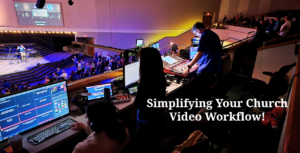
If you’ve ever felt like your church’s live streaming setup is a “house of cards”—where moving one cable or missing one volunteer causes the whole system to crash—you aren’t alone.
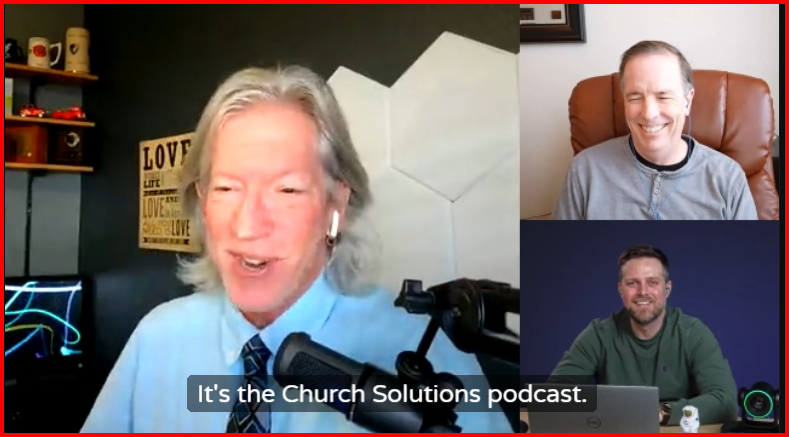
On Episode 503 of the Church Solutions Podcast, hosts Phil Thompson and Steve Lacy sat down with Dan Wallace from Epiphan Video to discuss a common problem: over-complexity. When your video workflow has too many “middlemen” (converters, splitters, and mystery boxes), reliability drops and stress levels rise.
The solution? Integration and simplicity. Here are the key takeaways from their conversation on how to make your church stream “broadcast without barriers.”
Why do churches keep getting stuck with complicated video systems?
Because church tech setups often grow like a junk drawer. One piece at a time.
A camera here. An encoder there. A converter. A switch. Another mystery box someone bought because “it was the best in its category.” Before long, your signal chain has more links than a Christmas playlist.
And the problem isn’t that each device is “bad.” It’s that every extra device adds a new failure point, a new cable, a new setting, and a new thing a volunteer has to understand.
In the episode, Phil and Steve shared a real scenario: a church where the encoder streamed fine, but the camera connection went sideways and the troubleshooting revealed multiple devices sitting between the camera and encoder. That’s the moment most churches recognize the real enemy:
Too much complexity.
What does “broadcast without barriers” actually mean for a church?
Dan described Epiphan’s mission as simplifying professional video so organizations (including churches) can create a consistent, repeatable video experience.
In church language, that means:
- Fewer “only Bob knows how it works” systems
- Less hunting for the right IP address on Sunday morning
- Less “it worked on Tuesday” mystery failures
- More confidence for volunteers
- More predictable results week after week
It’s not about chasing the fanciest gear. It’s about removing friction so your team can focus on ministry, not menus.
Why are PTZ cameras so popular in churches now?
PTZ cameras used to feel like glorified security cameras: herky-jerky movement, slow control, awkward setups.
That’s changed.
A PTZ camera (Pan-Tilt-Zoom) fits churches well because it can:
- Cover multiple angles with fewer camera positions
- Be controlled by a volunteer from a single spot
- Use presets (one button for pulpit, one for stage left, one for worship)
- Potentially reduce staffing needs
- Provide a cleaner, repeatable “Sunday look”
In short: PTZ cameras are often chosen for simplicity, and churches desperately need more of that.
What makes the Epiphan EC20 PTZ camera different?
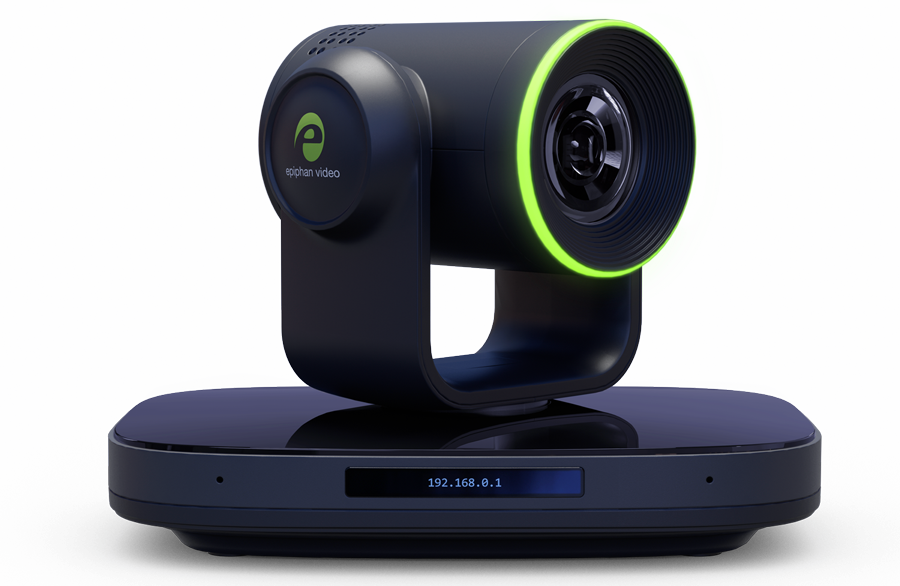
Dan highlighted a few “small things” that are actually big deals in real church setups.
1) It’s designed for fast setup (especially on a network)
One of the biggest friction points with PTZ cameras is the initial network setup. If you’ve ever played “Where is the camera on this network?” you know the pain.
The EC20 includes an LCD screen on the camera that shows key info like the IP address when you plug it in. That alone can save a bunch of setup time and confusion.
2) PoE+ support reduces power clutter
With PoE+ (Power over Ethernet), you can power the camera through the same network cable that carries data. That can mean:
- fewer wall adapters
- fewer power extension hacks
- cleaner installs
- fewer “did we plug the power brick in?” problems
3) Flexible video outputs: HDMI, SDI, USB, and NDI HX
Churches vary wildly. Some are all-SDI. Some are HDMI and prayers. Some want network-based video.
Dan noted the EC20 supports HDMI, SDI, and network protocols like NDI HX (specifically HX3), plus USB connectivity mentioned in the conversation.
The takeaway: you can use the camera in a lot of different environments without being locked into one approach.
4) Built-in tracking for “no operator” scenarios
If you don’t always have someone actively driving the camera, AI tracking can help.
Dan described presenter tracking modes that can follow a pastor across a defined zone and return to a preset (like the lectern) when the presenter leaves that area. The goal is simple:
A good result even when you don’t have a dedicated camera operator.
Do you have to own Epiphan gear for the EC20 to work?
No.
Dan emphasized the EC20 is designed to work with open protocols. You don’t need Epiphan Pearl devices to use the camera.
If you do use Epiphan gear, you may get extra benefits, especially around remote monitoring/management through Epiphan’s cloud service.
So the decision isn’t “Epiphan ecosystem or nothing.”
It’s more like:
- Works with most systems
- Works even better with Epiphan workflows
What is NDI HX and why should a pastor care?
NDI is a way to send video over your local network (not your internet). Instead of running long HDMI/SDI cables, your camera becomes available across your building on the network.
Dan explained it simply:
- Full NDI = higher quality, higher bandwidth, can saturate networks
- NDI HX = compressed, great quality with much lower bandwidth needs
He shared a practical reference point: NDI HX can be around 6 Mbps per camera, comparable to streaming video on a computer.
That matters because it helps churches estimate:
- 1 camera ≈ 6 Mbps
- 4 cameras ≈ 24 Mbps
- plus overhead and spikes
The real advice: don’t run your network at the redline. Leave headroom.
Can I run my church video system over Wi-Fi?

Dan’s answer was basically: please don’t.
Wi-Fi is great for phones and laptops. It’s not great for mission-critical video, especially when Sunday hits and the room fills up with a hundred extra devices.
That’s why Epiphan’s live encoders are designed around Ethernet instead of Wi-Fi: fewer surprises, fewer interference problems, more consistent performance.
The pattern churches see all the time:
- Tuesday test: flawless
- Sunday morning: chaos
That usually isn’t “the camera being moody.”
It’s the environment changing.
How fast does our church network need to be for NDI HX?
If your switch supports gigabit, you’re in a much better position.
Dan recommended leaving headroom, and suggested at least 25% headroom, with 2x headroom being a safer goal when possible because video traffic can spike.
If your church has multiple rooms and complex networking, this is where an IT person can really help, especially for:
- VLANs
- managed switching
- traffic isolation
- long cable runs
- multiple building segments
But for a single room and one or two cameras, many churches can make NDI HX work with modern basic infrastructure.
What does the EC20 cost?
Dan said pricing can change, but it’s around $2,000, and he pointed listeners to Epiphan’s website for current pricing and bundles.
He also mentioned bundles that pair a camera with an encoder for better pricing if you need the full workflow.
Can Epiphan encoders automatically start and stop streams for church services?
Yes.
Phil asked the practical church question: “Can I schedule streaming so it starts and stops automatically?”
Dan confirmed Epiphan encoders support automation and scheduling, which fits churches well because service times are predictable. He also mentioned workflow automation like transferring recordings to storage locations (Dropbox, NAS, etc.) to reduce manual steps.
This is one of those “small” features that becomes massive when your volunteer is late, sick, or stuck in the parking lot helping a guest.
What’s the real lesson churches should take from this episode?
If you remember one thing, make it this:
A reliable church video system is less about buying “the best” individual gear and more about designing a system that a volunteer can run without fear.
That means:
- reduce boxes
- reduce conversions
- reduce “secret knowledge”
- increase integration
- increase repeatability
- prioritize remote visibility and support
When the goal is ministry, the tech should stop acting like the main character.
Three Easy Next Steps

This week, take 15 minutes and do a quick “signal chain audit”:
- List everything between your camera and your encoder/switcher.
- Circle anything that feels unnecessary, outdated, or fragile.
- Pick one item to simplify or eliminate before next month.
Less gear. Fewer failure points. Happier volunteers. More consistent Sundays. 🎥✅
As always, StreamingChurch.tv can help you with any questions and you can also reach out to Epiphan.com and chat with a real person with any questions you may have.