One of my favorite things to do is hosting the Church Solutions Podcast. I think it goes back to my broadcasting days on interviewing people that I always enjoyed. So…on the latest Church Solutions Podcast, we talk again with founder and CEO Steve Lacy. If you’ve ever wondered what church tech looked like before “going live” was a button, before Facebook was a household word, and before webinars were… well, normal, this episode is a delightful little time machine.
In Episode 501 of the Church Solutions Podcast, hosts Phil Thompson and Steve Lacy take a Christmas-season stroll down memory lane, tracing the milestones that helped shape JSL Solutions and StreamingChurch.tv. Along the way: some early internet history, hard-earned lessons, a few “you had to be there” moments, and a reminder that the best parts of church tech are still… people.
A Christmas Hello (and a Hoodie Roast)
The episode opens with the kind of banter that feels like walking into a familiar church tech booth at a conference: friendly, slightly sarcastic, and immediately off-topic in the best way.
Phil points out Steve’s “tech guy” look (hoodie included), and Steve explains the origin story of his upgraded wardrobe: Co-worker Mike Gray once joked we all looked homeless. That comment may or may not have launched a new era of ties and collared shirts for Phil Thompson.
With Christmas about a week away in the conversation, Phil and Steve pause to wish listeners a Merry Christmas and Happy New Year, sharing genuine gratitude for customers, listeners, and churches they get to serve.
A Quick Nod to Episode 500
They briefly reference last week’s big milestone, Episode 500, where Phil interviewed Steve. If you missed it, they mention you can find the podcast through StreamingChurch’s resources and podcast channels (and yes, they admit there are multiple ways to get there).
Then they pivot to the main event: key moments since the company’s early beginnings.
2001: Launching MyFlock.com Before It Was Cool (or Common)
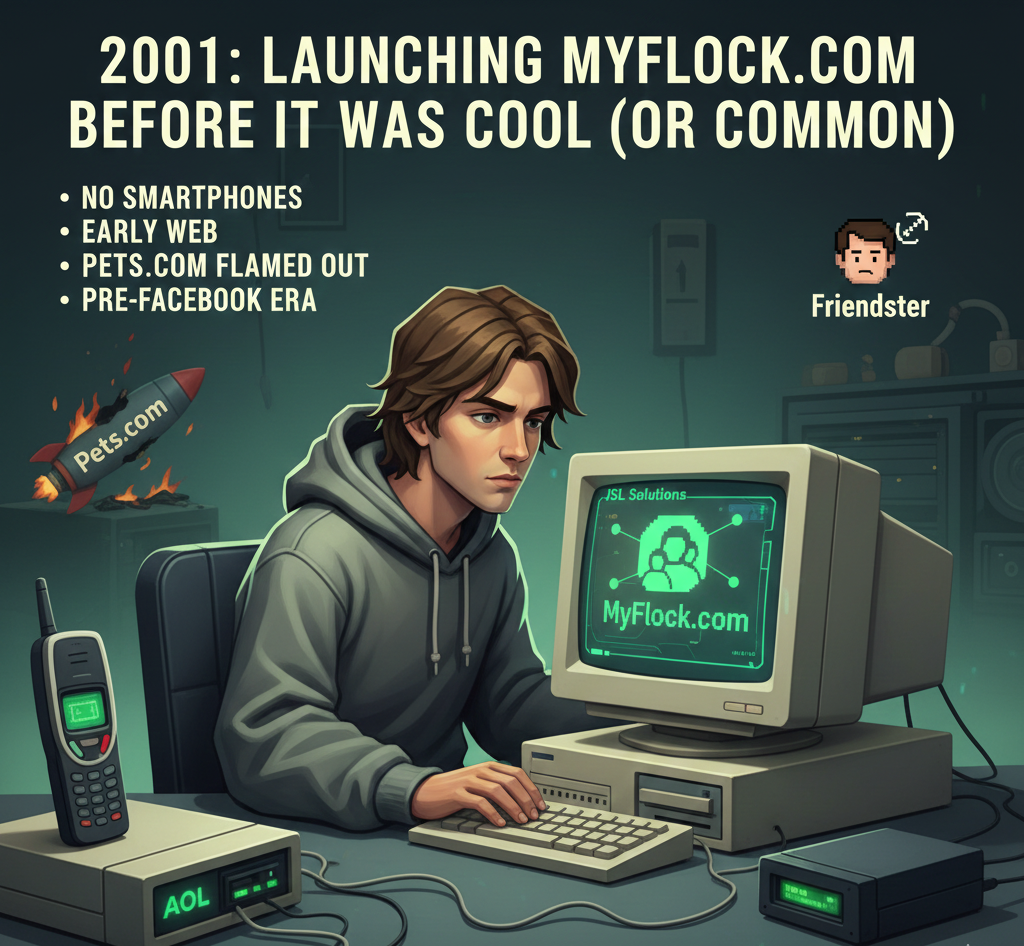
Steve takes us back to 2001, when he created JSL Solutions and launched MyFlock.com.
That year matters because it’s practically prehistoric by today’s standards:
- No smartphones
- The early web was still finding its legs
- Pets.com had already flamed out
- “Social” online was barely a concept
Steve mentions early “Facebook-ish” platforms like Friendster (and how scaling issues crushed it). The point: they were building web-based ministry tools before that was an obvious idea.
And yes, Phil jokingly claims Steve made “close to a billion dollars,” which Steve confirms with the exact seriousness the joke deserves.
The First Big Marketing Play: A Pastor Luncheon in Tucson
One of the most fascinating parts of the episode is how analog the early growth strategy was.
Steve decided to invite pastors across Tucson to a luncheon to introduce MyFlock. There was no polished online ad strategy. Instead, there was:
- A list of churches (around 400, by his memory)
- A mailer campaign
- A folding machine
- Kids and helpers stuffing envelopes at the kitchen table
- A luncheon at the Viscount Hotel
Result: 30–40 pastors showed up, and over half signed up.
Not only did it work, it was a defining moment: proof that churches wanted web-based tools, even before they knew they wanted web-based tools.
Taking It National: Atlanta, 5,000 Invitations, and a “Rickety Booth” Era
Encouraged by Tucson, they tried the same model in Atlanta at a Christian Computing conference led by Steve Uitt (Christian Computing magazine).
This time it wasn’t 400 invitations.
It was 5,000.
They built an early trade show booth out of what sounds like a sacred combination of PVC and Velcro, and Steve admits he expected it to collapse overnight.
The turnout wasn’t as strong as Tucson (40-ish pastors), but something bigger happened:
- They became a “buzz” vendor at the conference
- The conference host spoke highly of them
- They got visibility, legitimacy, and momentum
And then came the famous moment with a neighboring vendor…
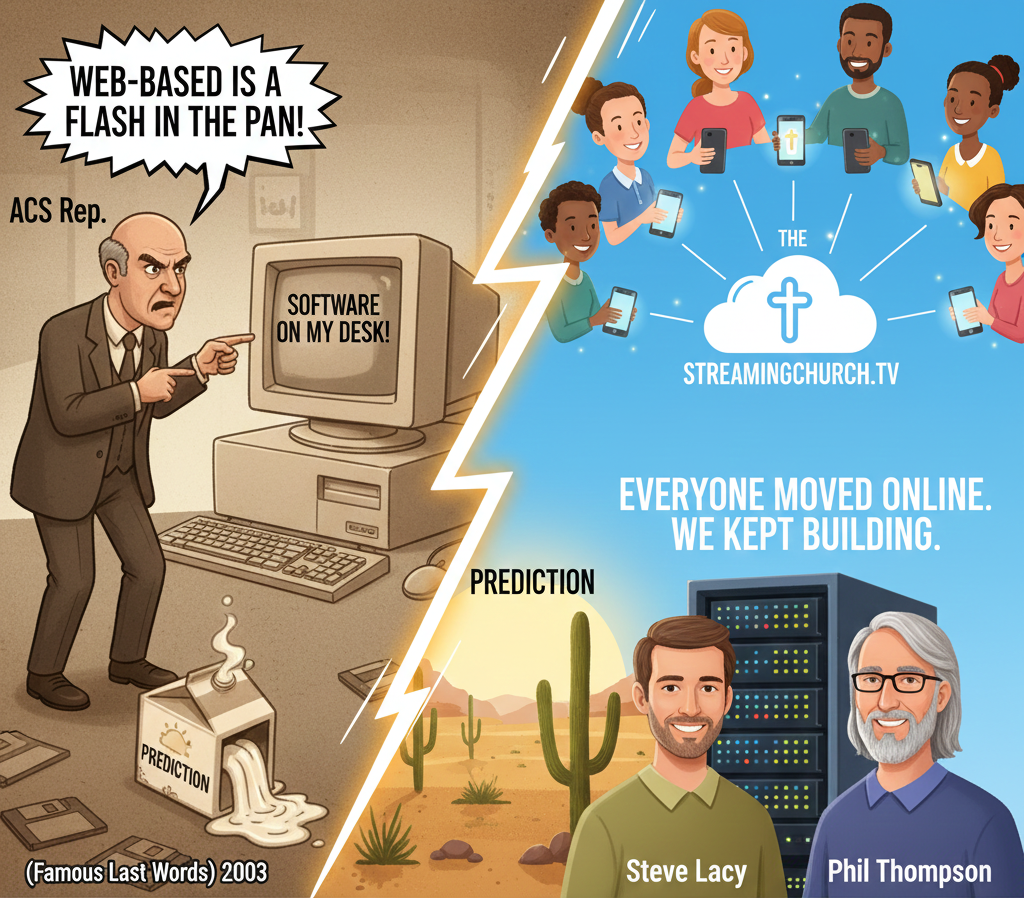
“Web-Based is a Flash in the Pan” (Famous Last Words)
A representative from an established church management system vendor (Steve recalls it may have been ACS) told them, in essence:
“This web-based thing won’t last. People want software on the church computer.”
That prediction aged like milk in Tucson sun.
They point out that everyone eventually moved online, including the skeptics. It’s one of those satisfying “keep building” moments, the kind you remember when you’re exhausted and trying to ship something new.
2003: Webinars When Webinars Were Weird (and Expensive)
Steve shares that they started doing webinars around 2003, but not like today.
No Zoom. No one-click links. No cheap or free platforms.
He used a service that charged $0.25 per minute per attendee.
That means every minute felt like it was ticking out of your wallet.
They tried using a Nazarene pastor network connection to reach more leaders, and while the webinars weren’t as fruitful as the early seminars, the bigger takeaway was clear:
This was a new frontier, and they were stepping into it early.
2004: Acquisition by Digital IMS (Exciting… Then Frustrating)
Another major milestone: Steve explains how they were acquired by Digital IMS.
It started after conferences and conversations with a company getting into church websites. They invited Steve to their headquarters, wined and dined the team, then made the pitch:
“We’d like to either merge or acquire you guys.”
For Steve, it was surreal: something that began in a bedroom on a home computer was suddenly acquisition-worthy.
The arrangement:
- Digital IMS would handle billing, support, and marketing
- MyFlock customers would slowly migrate to their platform
- Steve would be on salary for a time
But after about a year, Digital IMS shifted focus away from ministry, and the partnership became frustrating. Eventually, Steve negotiated to get the customers back, essentially undoing the arrangement and continuing forward independently.
A key lesson in founder life: sometimes “being acquired” is less of a finish line and more of a plot twist.
Hiring the Kids: Building a Family Pipeline of Coders (and Helpers)
Phil highlights something personal and meaningful: Steve hired his kids for summer work, teaching them coding and giving them a real start.
Steve explains how he guided them using online lessons, then gave them real tasks to apply what they learned. Over time, multiple kids (and even friends) gained early experience through the business.
It’s one of those quiet legacy moments: not just building a product, but building people.
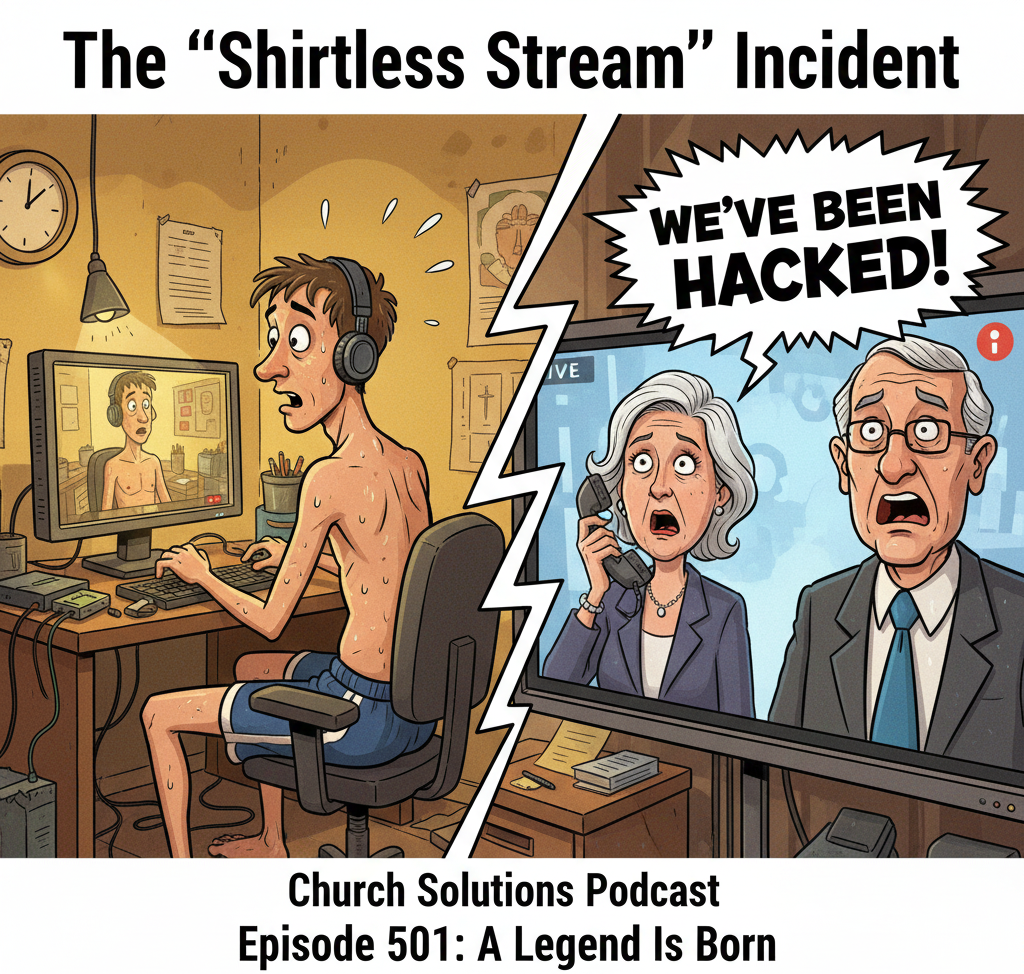
The “Shirtless Stream” Incident (a Legend Is Born)
This is the moment that will live forever in Church Tech Hall of Fame.
Steve describes assigning his youngest son to test streams across multiple accounts. The idea was simple: send a stream, confirm it appears, move on.
But on one particular day, a ministry conference was streaming at the same time. Suddenly the phones started lighting up:
“We’ve been hacked!”
The “hacker” was actually Steve’s son… testing streams at home… shirtless… in Tucson summer heat.
A “skinny shirtless young kid” appeared on the conference stream.
They were not amused.
Steve calls it an “oops,” but honestly it’s also a perfect reminder that in streaming, there’s no such thing as a “safe time” to test. Somewhere, someone is always live.
2020: COVID Weekend, 10x Viewers, and a Decision to Pause Growth
When the conversation turns to March 2020, the tone shifts from nostalgic to intense.
Steve and Phil describe the chaos when churches suddenly had to stream:
- Many churches weren’t streaming at all
- Churches that had 40–50 online viewers suddenly had 1,500
- Servers weren’t scaled for a worldwide “everybody stream now” weekend
- Support requests exploded
They faced a brutal tradeoff: keep onboarding new churches or stabilize for the churches already depending on them.
They made a hard, principled decision: create a waiting list and pause new signups temporarily so they could stabilize and serve faithfully through the surge.
It was all-hands-on-deck:
- They hired help (including Michael Gray)
- Staff shifted roles (customer support became priority #1)
- Even family pitched in, including a son furloughed from his dentistry work
They also share how they coached churches through “bare minimum streaming” setups:
- “Do you have a laptop?”
- “Put it on a stack of bricks.”
- “Use a free encoder.”
- “Let’s go live.”
It wasn’t fancy, but it worked.
And yes, Easter was coming fast, which added extra pressure, but they made it through.
The Ongoing Reality: Bots, Hacks, and “They Only Attack When Steve’s on Vacation”
As the episode wraps, Phil notes that the stress hasn’t disappeared. Like any online platform, StreamingChurch.tv deals with:
- bogus account creation
- bot attacks
- attempted hacking
Phil jokes that these things happen especially when Steve goes on vacation, which feels like the internet’s version of timing a jump scare.
The Best Part: Encouraged Churches and Measurable Impact
Steve closes with what he says is his biggest pleasure: hearing from satisfied churches and seeing the impact.
He shares a big number with simple gratitude:
- Over 6 million unique people have joined services through the platform
- Total viewers overall would be far higher (hundreds of millions), but “unique” counts first-time individuals only
Phil notes that compared to giant tech platforms, that number might look “small,” but in ministry terms, it’s enormous and meaningful.
Phil’s Reflection: A Joyful Journey and Real Partnership
Phil adds his own summary of the journey since about 2009–2010:
- customer service work
- launching and maintaining the blog
- building the early podcast/video podcast rhythm
- helping set up social media channels
And yes, he jokingly points out Steve didn’t include “hiring Phil” on the memorable milestones list, but Steve responds with sincere appreciation and calls Phil a long-time right-hand partner.
Final Thoughts
Episode 501 is part Christmas greeting, part origin-story highlight reel, part reminder that the church tech world didn’t start with livestream buttons and chat overlays. It was built in slow, scrappy layers:
- kitchen-table mailers
- rickety booths
- expensive webinars
- unexpected acquisitions
- family members helping
- chaotic global pivots
- and steady commitment to serving churches well
They close by wishing everyone a Merry Christmas and Happy New Year, thanking listeners for being part of the Church Solutions Podcast community and StreamingChurch.tv
If we can help you and your ministry, reach out to us today at StreamingChurch.tv.
Merry Christmas and Happy New Year from:
Steve lacy, Phil Thompson, Michale Gray and the StreamingChurch.tv Team!