

If you’ve ever walked out of a Sunday service thinking, “The music was fine… but I couldn’t understand half the message,” you are not alone.
On Episode 505 of the Church Solutions Podcast, Phil Thompson and Steve Lacy sat down with Jim Murphy, founder of Sound Concepts, to talk about the most common sound problems churches face, why they keep happening decade after decade, and what actually moves the needle (even when budgets are tight).
Jim has been serving churches in audio and systems design since the 1980s, and he brings a perspective that’s part technician, part engineer, part ministry translator. The main theme? Church audio isn’t just about making things louder. It’s about making things clear.
Let’s unpack the big takeaways and translate them into practical next steps you can use in your own worship space.
The Real Enemy: “Loud Enough” Isn’t the Goal
One of the most important distinctions Jim makes is this:
Church sound is not primarily a study of volume.
It’s a study of clarity at every seat.
In sound-world terms, the word you’ll hear a lot is intelligibility.
That’s the ability for people to clearly understand spoken words, especially consonants. Jim explains that S’s, T’s, and D’s are tricky to reproduce in reverberant rooms, and when those details get smeared, people can’t tell the difference between words like:
- “bad” and “bat”
- “back” and “bat”
Which is not ideal when you’re trying to communicate the Gospel with precision.
The scary part: you might think your system is “fine” because the room feels loud… while half the room is quietly decoding the sermon like it’s a muffled voicemail.
The Timeless Church Sound Problem: Reverberation
Jim says the most consistent sound problem churches face, from then to now, is:
Too much reverberation… and not enough intelligibility.
The larger the room (and the higher the ceilings), the worse this tends to get. Cathedrals and older sanctuaries can become natural echo chambers before you even plug anything in.
So what do you do?
Jim’s answer is surprisingly grounded: before you design a sound system, you have to understand the acoustics of the space.
That doesn’t always mean expensive renovations. But it does mean you can’t ignore the room and just “buy better speakers” and hope for a miracle.
“Do We Need to Change the Room Before We Buy Gear?”
Sometimes… yes.
Jim shares that his team can use modeling software (he mentions EASE) to build a wireframe of the room and predict what will happen at different seats and frequencies.
That allows you to test things like:
- speaker placement options
- speaker models and dispersion patterns
- whether acoustic treatments would help, and where
- what frequencies are causing the most trouble
But Jim is also realistic: most churches don’t have the budget for a full acoustic redesign.
So the practical approach is usually:
- Understand the room (even in a simplified way)
- Place speakers correctly
- Choose speakers designed for spoken word clarity
- Treat the room only where it provides the biggest impact
Worship Style Matters (More Than People Think)
Here’s a nuance most churches miss:
Different worship styles call for different reverberation “targets.”
Jim explains it like this:
- Contemporary music (faster rhythms) needs shorter reverberation time, or beats stack on top of each other and the mix turns into sonic soup.
- Traditional worship (choir/organ) often benefits from longer reverberation time, because the sound needs space to develop.
He also warns about something that happens more often than you’d think:
A church installs lots of acoustic damping to help spoken word clarity… but doesn’t retune (or re-balance) the room for things like a pipe organ that was originally voiced for that space.
Result: spoken word improves, but the organ can sound flat and lifeless.
The Drummer Problem (Yes, That One)

Phil brings up a very real ministry scenario:
A 300-seat church. Contemporary band. Enthusiastic drummer. Stage volume is out of control.
Jim’s response is refreshingly practical:
- The “fix” isn’t one magic product.
- The options people use (drum shields, pillows in kick drums, damping, cages) are all valid tools.
But he says the true solution depends on the drummer and the room.
If the drummer can’t play with energy at low volume…
A drum enclosure/cage is often the answer.
And yes, if you enclose the drums, you’ll need to:
- mic the kit
- put the sound back into the system strategically
He mentions multi-mic drum kits (like 7-mic setups) as a common approach.
Also, one detail that made everyone laugh because it’s painfully true:
Drum cages need air movement. Not just for comfort, but because… well… it gets ripe in there 😄
The “Stage Volume War” (and the Sneaky Fix)
Jim also tackles the broader stage-volume issue: loud amps, wedges, drums, and everyone trying to hear themselves.
He points to two big solutions:
1) In-ear monitors (done carefully)
He’s cautious with volunteers because you can damage ears quickly if it’s mixed poorly.
2) “Hotspot” monitoring (his favorite practical option)
This is counterintuitive but smart:
Put small monitors very close to the musician, so you can run them quieter overall.
If the speaker is far away, you turn it up.
If it’s close, you don’t need as much volume.
Same volume into the mic. Less chaos across the stage.
He adds other common-sense moves:
- tilt guitar amps toward the player’s ears (so they don’t blast the room)
- isolate loud instruments when needed (like moving a Leslie to another room)
The Shock Moment: “95% of Churches Aren’t Dialed In”
This is the line that makes you sit up straighter.
Jim says that in his experience, around 95% of church sound systems are not dialed in correctly.
Why?
Because most churches are budget-conscious, and many rely on volunteers or someone with a “bar band” background. Those folks can absolutely be talented, but designing a sanctuary for spoken-word intelligibility is a different discipline than setting up a portable gig.
Jim puts it bluntly:
It’s a mistake to tell the sound person to “just put speakers in.”
Speaker placement and coverage are engineering problems, not preferences.
“I’ve Got $1,000. What Should I Do?”

Phil asks a question every pastor has either asked out loud or thought while staring at a scratchy handheld mic:
“What can I do with $1,000?”
Jim’s advice is not “buy a better mixer” or “get new speakers.”
He says:
Spend part of that money on a speaker placement study with a qualified systems integrator who understands room acoustics and spoken-word coverage.
He suggests that in many markets, if the church can provide room dimensions and basic drawings, a study might run roughly $250–$500 for a simple case.
Then you take the plan and have someone local install properly.
In other words:
Don’t spend your whole budget on gear.
Spend enough to avoid spending the next 10 years fixing your mistake.
The Biggest Mistake Churches Make: Hiding Speakers
There’s a moment where Phil and Steve acknowledge the common tension:
Churches often place speakers where they look best, not where they work best.
Jim’s answer:
Moving speakers can make a night-and-day difference.
He tells a story about a small church where someone installed four speakers: two in front corners and two in back corners. Sound came from everywhere at once, including behind people’s heads, creating a mess of competing arrival times.
The fix wasn’t “more speakers.” It was fewer speakers, placed correctly, with the right coverage pattern.
Brand Doesn’t Come First (Metrics Do)
Jim also takes a swing at “cool kid” brand-chasing.
His philosophy:
You don’t start with a brand.
You start with what the room needs.
Once you understand the room metrics and the coverage goal, you choose equipment that fits those requirements.
Yes, some manufacturers build premium systems. But the real win is matching the right tool to the problem, not buying what another church bought because it looked impressive on Instagram.
Practical Next Steps for Your Church
If you’re reading this and thinking, “Okay… what do I do Monday morning?” here’s a simple path:
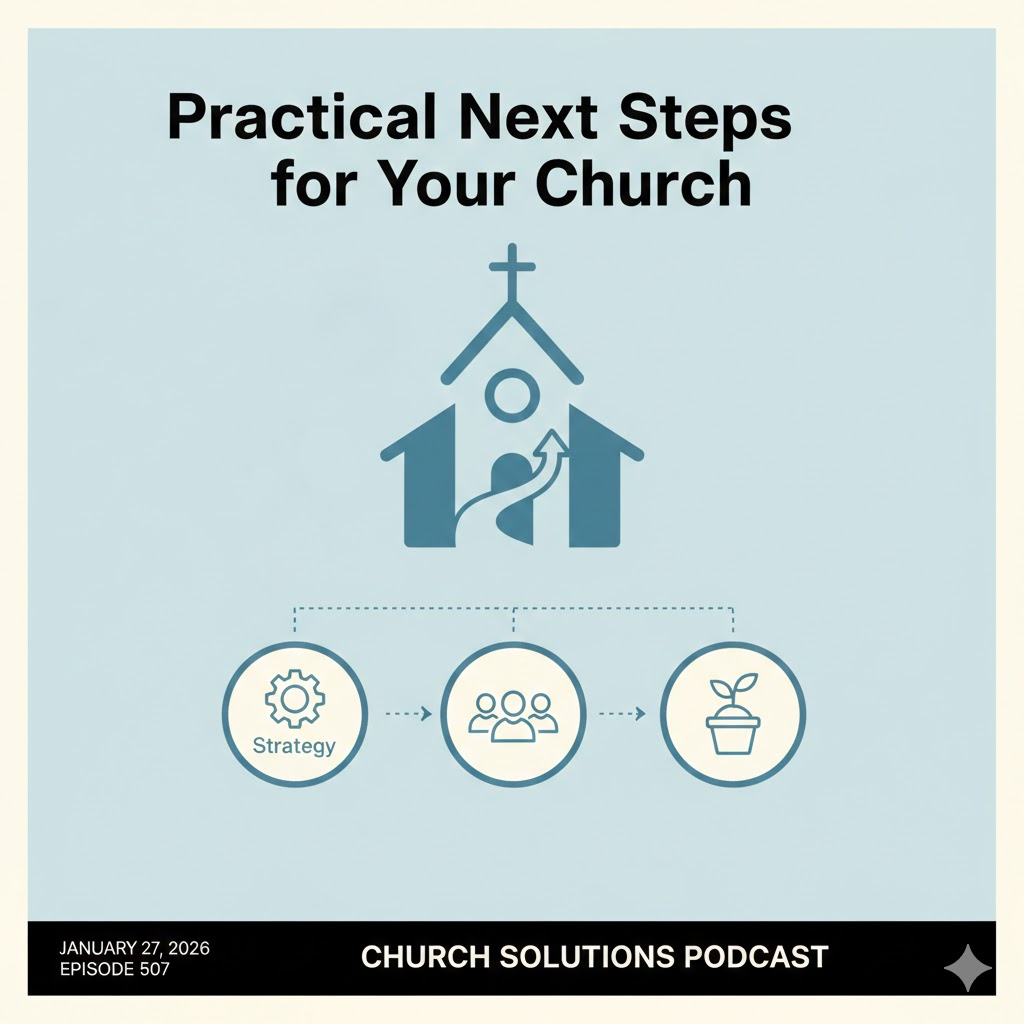
1) Identify your primary pain point
- “We can’t understand the sermon.”
- “The stage is too loud.”
- “The back half of the room complains.”
- “It sounds different every week.”
2) Stop guessing and start measuring
Even basic room dimensions and seating layout can get you moving in the right direction.
3) Invest in placement and coverage planning
A modest speaker placement study can prevent years of frustration.
4) Address stage volume before you touch the FOH mix
If the stage is roaring, the house mix will always feel like damage control.
5) Train volunteers to protect the system
Jim makes a great point: even a well-designed system can be “broken” if volunteers constantly change settings they don’t understand. Your best friend here is:
- locked presets
- simplified workflows
- documented “do not touch” settings
- a consistent weekly checklist
Want Help From Jim Murphy?
Jim Murphy is the founder and leader of Sound Concepts, a company that designs high-quality communication, audio, and video systems for houses of worship, schools, and corporate environments.
You can connect with him and he notes that he can work with churches anywhere, even if he’s not physically on location.
For those of you who made it this far, Below is a link to a bonus tool the help you review your sound.
Church Sound Clarity Quick Diagnostic Tool
Final Thought
If your church sound system has been “almost good” for years, Jim’s message is both comforting and challenging:
You’re not failing.
You’re dealing with physics.
And the good news is, when you approach church audio as a clarity problem (not a loudness problem), real improvement becomes possible, even on a modest budget.
Because when people can clearly hear, they can clearly engage.
And that’s the point. 🎙️
Make sure you subscribe to the Church Solutions Podcast and never miss an episode.
You can reach Jim Murphy by going to SoundConceptsLLC.com or reach out to StreamingChurch.tv