Answers to Pastoral Burnout and Declining Public Trust

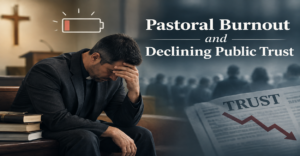
I have witnessed this first hand as a pastor, in recent years, the conversation around church leadership has shifted dramatically. While the acute survival panic of the pandemic era has eased, ministry leaders are now facing a quieter, more complex reality: a combination of persistent vocational strain and an increasingly skeptical cultural landscape.
The Paradox of Pastoral Well-Being
Recent data from organizations like the Barna Group highlights a fascinating paradox among church leaders:
- The Good News: Emotional resilience has rebounded. Acute feelings of inadequacy and mental exhaustion among pastors have steadily dropped from their post-pandemic peaks, and confidence in a personal calling to ministry has strongly recovered.
- The Hidden Drag: Despite feeling more emotionally equipped to lead, overall vocational satisfaction has quietly slipped to historic lows. Nearly one in four pastors still seriously considers leaving full-time ministry, often driven not by a crisis of faith, but by structural misalignment, heavy administrative loads, and a lack of delegation.
Take it from me, I was in ministry for over 4 decades. When leaders feel isolated or are forced to carry the institutional weight entirely alone, resilience wears thin. I experienced this.
The Trust Deficit in Public Life
Compounding this internal fatigue is an external challenge: institutional trust. Public confidence in clergy and religious organizations sits near historic lows.
For decades, the local pastor held a default position of trusted community counselor and moral anchor. Today, clergy often find themselves painted with the broad brush of skepticism directed at all major institutions—religious, political, and corporate. This cultural skepticism means modern pastors must work much harder to earn basic relational credibility before any meaningful spiritual guidance can take root.
Moving From Isolation to Shared Ministry

How do congregations and leaders weather this season? The data points to a few essential shifts:
- Redefining Support Systems: Pastors who thrive intentionally build networks outside their immediate local church—peer mentors, professional counseling, and safe spaces where they can be human rather than infallible.
- Distributed Leadership: Burnout spikes when a congregation views the pastor as a “professional proxy” meant to do all the heavy lifting. Healthy churches are actively shifting toward shared-ownership models, where elders, staff, and volunteers co-labor to carry the ministry.
- Restoring Transparency: Rebuilding public trust starts locally. Churches that lean into radical authenticity, acknowledge their limitations, and openly talk about mental health and human struggle create environments where skepticism turns into safe, honest dialogue.
It’s 2026 not 1976. Modern ministry is now caught between internal fatigue and external skepticism. While pastoral emotional resilience has rebounded, vocational satisfaction remains fragile as leaders battle high workloads and cultural distrust toward institutions. Overcoming this requires moving away from the “professional proxy” model—where the pastor carries everything alone—and building a culture of shared leadership, genuine transparency, and deep community support.
At StreamingChurch.tv we have resources that can help you if you are dealing with the things mentioned above. Just go to StreamingChurch.tv or email Phil Thompson, Phil@StreamingChurch.tv. Confidentiality is assured.